Material Issues,
Targets and Results

Identifying
Material Issues
-
- (i)Selecting candidates for material issues
-
In addition to referring to international guidelines and rules, such as the goals and targets contained within the SASB (Sustainability Accounting Standards Board) standards and the SDGs (Sustainable Development Goals), industry trends and the perspectives of ESG rating agencies are also taken into consideration in identifying issues that are highly relevant to the Group. Furthermore, material issue candidates are selected from both external and management perspectives through discussions and other communication between Directors of the Company and institutional investors.
-
- (ii)Assessing the importance of issues
-
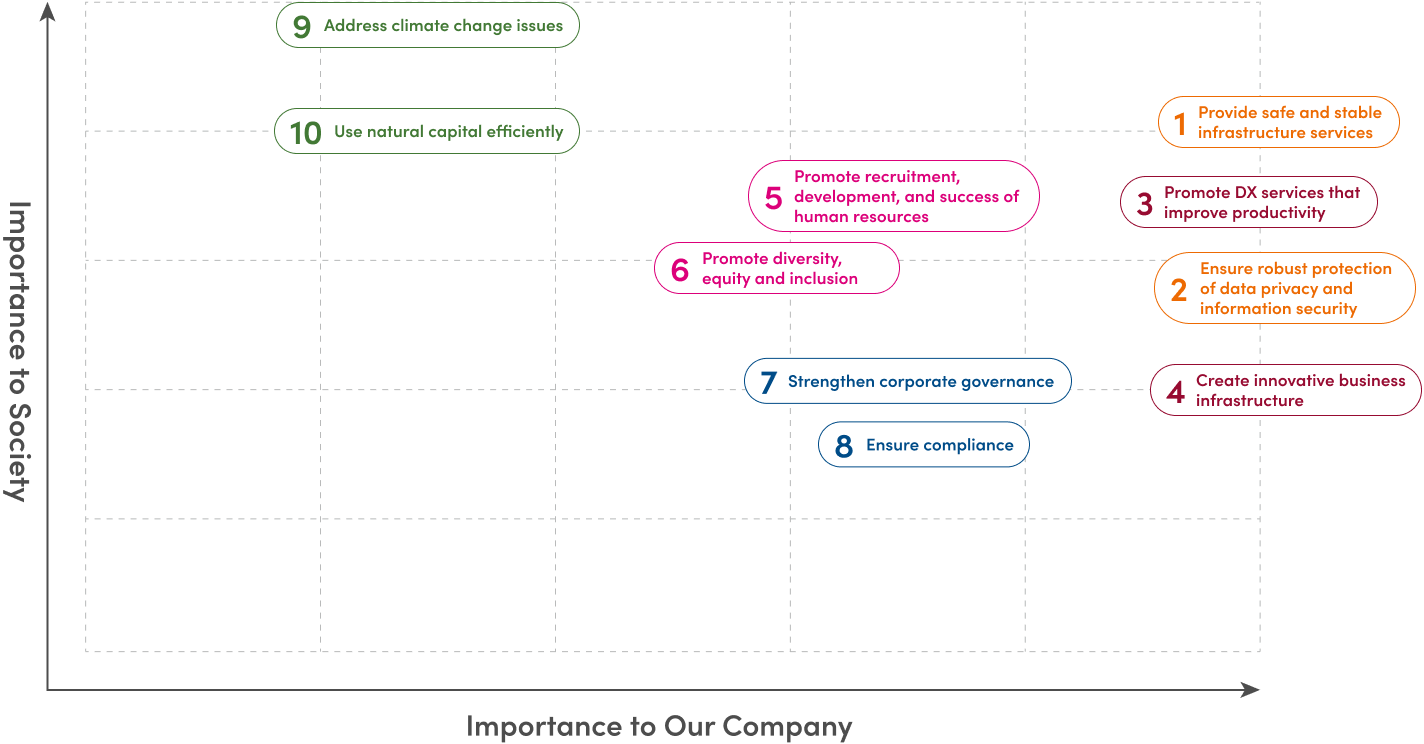
The issues selected in (i) are each assessed along two axes. One is the importance of the issue to society (stakeholders) in terms of achieving a sustainable society, and the other is the importance of the issue in terms of achieving the Group’s vision and driving the growth of the business. These assessments are conducted by all Directors individually, incorporating expertise and diverse perspectives to visualize the prioritization of the issues.
-
- (iii)Discussions and decisions by the Board of Directors
-
The results of the assessments conducted in (ii) are discussed and deliberated by the Board of Directors, which identifies material issues. The content of the identified material issues is reflected in strategic initiatives under the oversight of the Directors who serve as material issue owners. At the Board of Directors meeting held in August 2022, 10 material issues were identified and organized into 5 areas. Subsequently, at the Board of Directors meeting held in August 2023, long-term quantitative targets for the fiscal year ending May 31, 2030 were formulated.
5 priority areas and 10 Material Issues
-
- Area 1
-
Balance Security and Convenience
Besides convenience, we also implement measures to ensure that our employees maintain data privacy and information security, thereby providing society with a highly safe and stable service.
Officers (material issue owners)
Director, Executive Officer, CISO, DPO
Kenji ShiomiMaterial issues
- 1. Provide safe and stable infrastructure services
- 2. Ensure robust protection of data privacy and information security
Metrics and targets for fiscal year ending May 31, 2030 *1
- Number of major incidents: 0
- Proportion of those qualified as Protection of Individual Information Person: maintained at 80% or higher
Results for fiscal year ended May 31, 2026 *1
- Number of major incidents: 0
- Proportion of those qualified as Protection of Individual Information Person: 87.6%
-
- Area 2
-
Transform Work Through Innovative AX Services
To become business infrastructure, we will leverage our strengths in digitization to develop and provide innovative AX services that substantively improve social and economic productivity.
Officers (material issue owners)
Director, Executive Officer, COO
Kei TomiokaMaterial issues
- 3.Promote AX services that improve productivity
- 4.Create innovative business infrastructure
Metrics and targets for fiscal year ending May 31, 2030 *1
- Number of items converted from analog to digital information using our services: 500 million
- Number of users of our services: 20 million people
Results for fiscal year ended May 31, 2026 *1
- Number of items converted from analog to digital information using our services: 320 million *2
- Number of users of our services: 11.29 million people *2
-
- Area 3
-
Respect Employee Diversity and Producing Innovation
To produce innovation that helps solve business challenges through the power of encounters, we promote creation and provision of opportunities and environments for our diverse workforce to succeed.
Officers (material issue owners)
Director, Executive Officer, CHRO, CAXO
Yuta OhmaMaterial issues
- 5. Promote recruitment, development, and success of human resources
- 6. Promote diversity, equity and inclusion
Metrics and targets for fiscal year ending May 31, 2030 *1
- Proportion of recruitment through referrals: 35%
- Unipos *3 (peer bonus) posting rate: 80%
- Ratio of female employees in management positions: 30% or higher
- Ratio of female employees: 45% or higher
Results for fiscal year ended May 31, 2026 *1
- Proportion of recruitment through referrals: 10.0%
- Unipos *3 (peer bonus) posting rate: 50.9%
- Ratio of female employees in management positions: 19.9%
- Ratio of female employees: 36.2%
-
- Area 4
-
Establish a Firm Management Structure to Support Rapid Business Growth
To support our growth under a multiproduct structure, we will reinforce our management structure by strengthening corporate governance and ensuring compliance.
Officers (material issue owners)
Director, Executive Officer, CFO
Muneyuki HashimotoMaterial issues
- 7. Strengthen corporate governance
- 8. Ensure compliance
Metrics and targets for fiscal year ending May 31, 2030 *1
- Ratio of female Directors: 30% or higher
- Number of significant compliance violations: 0
- Proportion of employees receiving compliance-related training: 100%
Results for fiscal year ended May 31, 2026 *1
- Ratio of female Directors: 20.0%
- Number of significant compliance violations: 0
- Proportion of employees receiving compliance-related training: 100%
-
- Area 5
-
Conserve the Environment Through Business
We will promote environmental conservation by addressing climate change issues through our business activities, including advancing AX, supporting paperless work, and introducing environmentally friendly services.
Officers (material issue owners)
Representative Director & CEO, CPO
Chikahiro TeradaMaterial issues
- 9. Address climate change issues
- 10. Use natural capital efficiently
Metrics and targets for fiscal year ending May 31, 2030 *1
- Scope 1+2 *4: carbon neutral
- Number of uses of paperless functions in our services: 120 million
Results for fiscal year ended May 31, 2026 *1
- Scope 1+2 *4: 166 t-CO2
- Number of uses of paperless functions in our services:: 30 million *2









- *1 Due to the current difficulty in obtaining the numerical results necessary to calculate consolidated results, these figures are based on the non-consolidated results of Sansan, Inc. and cover 96.0% (percentage of non-consolidated net sales to consolidated net sales) of our business scope as of fiscal year ended May 31, 2026.
- *2 Results for the Company’s services are aggregated for Sansan, Bill One, Contract One and Eight.
- *3 Unipos is a service centered on the peer bonus® system provided by Unipos, Inc.
- *4 Scope 1 is calculated by aggregating direct GHG emissions from our own offices and facilities. Scope 2 is calculated by aggregating by indirect GHG emissions from the use of purchased electricity and thermal energy in each office.
Strategy
Directors serving as material issue owners in the Group take responsibility for promoting various initiatives related to the 5 priority areas and 10 material issues that have been identified. In each area, analyses are conducted on risks and opportunities, and their impact on our business model and value chain and financial impact, and the results are reflected in measures aimed at achieving the targets for the fiscal year ending May 31, 2030.
Note that quantitative information is currently not provided for the financial impact because it is uncertain whether each risk is materialized and it is difficult to classify and identify the amount of impact due to the combined effects of multiple factors.
| Priority areas | Impact on our business model and value chain | Financial impact | |
|---|---|---|---|
| (1)Balance Security and Convenience | Risks | As the Group provides services that handle customers’ important information assets, events such as personal information leaks or system failures, whether caused by natural disasters, unauthorized access, internal negligence, or other causes, may result in loss of customer trust and exposure to legal risks. Furthermore, the addition of various functions and other enhancements may necessitate the implementation of more advanced information security measures. | – Decrease in net sales due to reduced reliability – Incurrence of costs associated with a claim for damages or recovery costs, arising from an information leak or a system failure |
| Opportunities | By providing highly reliable services that achieve both convenience and security under advanced information security measures, the Group may be able to expand its customer base and improve the rate of continued service use. In addition, having advanced approaches to legal compliance and privacy protection can enhance the Group’s reputation and contribute to acquiring new customers. | – Increase in net sales due to improved reliability | |
| (2)Transform Work Through Innovative AX Services | Risks | If the Group falls behind in responding to changes in technological trends or customer needs, its services may lose competitiveness, leading to customer attrition or the obsolescence of its offerings. In addition, if the productivity gains expected from the use of the Group’s services are not sufficiently realized, this may affect the acquisition of new customers as well as the decisions of existing customers on continued service use. | – Decrease in net sales due to lower competitiveness – Increase in development costs for responding to technological innovations |
| Opportunities | By providing innovative services and functions that lead to workstyle transformation and productivity improvement, the social value of each service may increase, potentially driving further business growth. In addition, if the Group’s services come to function as part of the foundation for society and businesses, this may contribute to the realization of more sustainable growth. | – Increase in net sales due to improved service value | |
| (3)Respect Employee Diversity and Producing Innovation | Risks | If the acceptance of diversity and the fostering of an inclusive organizational culture are insufficient, employee retention may decline, potentially impairing the productivity and creativity of the organization. A decline in employee engagement could lead to an increase in employee turnover, which in turn may raise recruitment and training costs. Furthermore, inadequate responses to various forms of harassment and other similar misconduct could give rise to reputational risks. | – Decrease in net sales due to reduced development capabilities – Increase in recruiting and training expenses |
| Opportunities | By developing an environment in which a diverse workforce can thrive, it becomes possible to generate creative innovation and respond to a wide range of customer needs, thereby enhancing the Company’s competitiveness. In addition, by maintaining and improving employee engagement, an organizational culture can be fostered in which each individual can leverage their strengths, potentially leading to the further acquisition of talented personnel. | – Increase in net sales due to creation of new services – Decrease in recruiting and training expenses |
|
| (4)Establish a Firm Management Structure to Support Rapid Business Growth | Risks | If the governance structure and internal controls fail to keep pace with the rapid business growth, inappropriate decision-making or violations of laws and regulations, and other similar issues could occur, which may have a serious impact on the Company’s business operations and social credibility. In addition, if awareness of compliance is not sufficiently instilled amid the rapid expansion of the organization, the effectiveness of internal controls could be diminished. | – Decrease in net sales due to impaired reliability – Incurrence of costs for responding to a compliance violation incident |
| Opportunities | Establishing an appropriate governance structure can serve as a firm and robust management structure that supports prompt and sound decision-making and may lead to the sustainable growth of the business. In addition, ensuring the transparency and reliability of the governance structure can facilitate constructive dialogue with various stakeholders and may contribute to the enhancement of corporate value over the medium to long term. | – Increase in net sales due to improved reliability – Securement of stable financing framework due to enhanced transparency |
|
| (5)Conserve the Environment Through Business | Risks | If measures for decarbonization, the circular economy, and other related initiatives are insufficient, evaluations from stakeholders, including customers and investors, may deteriorate, leading to a decline in the competitiveness of each service. In addition, costs associated with climate change countermeasures could increase. | – Decrease in net sales due to reduced reliability – Increase in energy-related costs |
| Opportunities | Providing services and functions that help reduce environmental impact may increase customer preference for the Company’s services, potentially leading to further business growth. In addition, implementing appropriate climate change countermeasures could reduce future costs and contribute to improving the Company’s profit margin. | – Increase in net sales due to the acquisition of new demand – Decrease in energy-related costs |
Materiality Map